
Modern businesses need to release software quickly without affecting user experience. However, deploying updates directly to production can introduce bugs, downtime, and service interruptions. To overcome these challenges, organizations use deployment strategies that reduce risks while ensuring continuous availability.
One of the most popular approaches is DevOps Blue-Green Deployment. This deployment strategy allows teams to release new application versions with little or no downtime while providing an easy rollback option if issues occur.
In this guide, we’ll explain DevOps Blue-Green Deployment, how it works, its benefits, best practices, and how it compares with other deployment strategies.
What is DevOps Blue-Green Deployment?
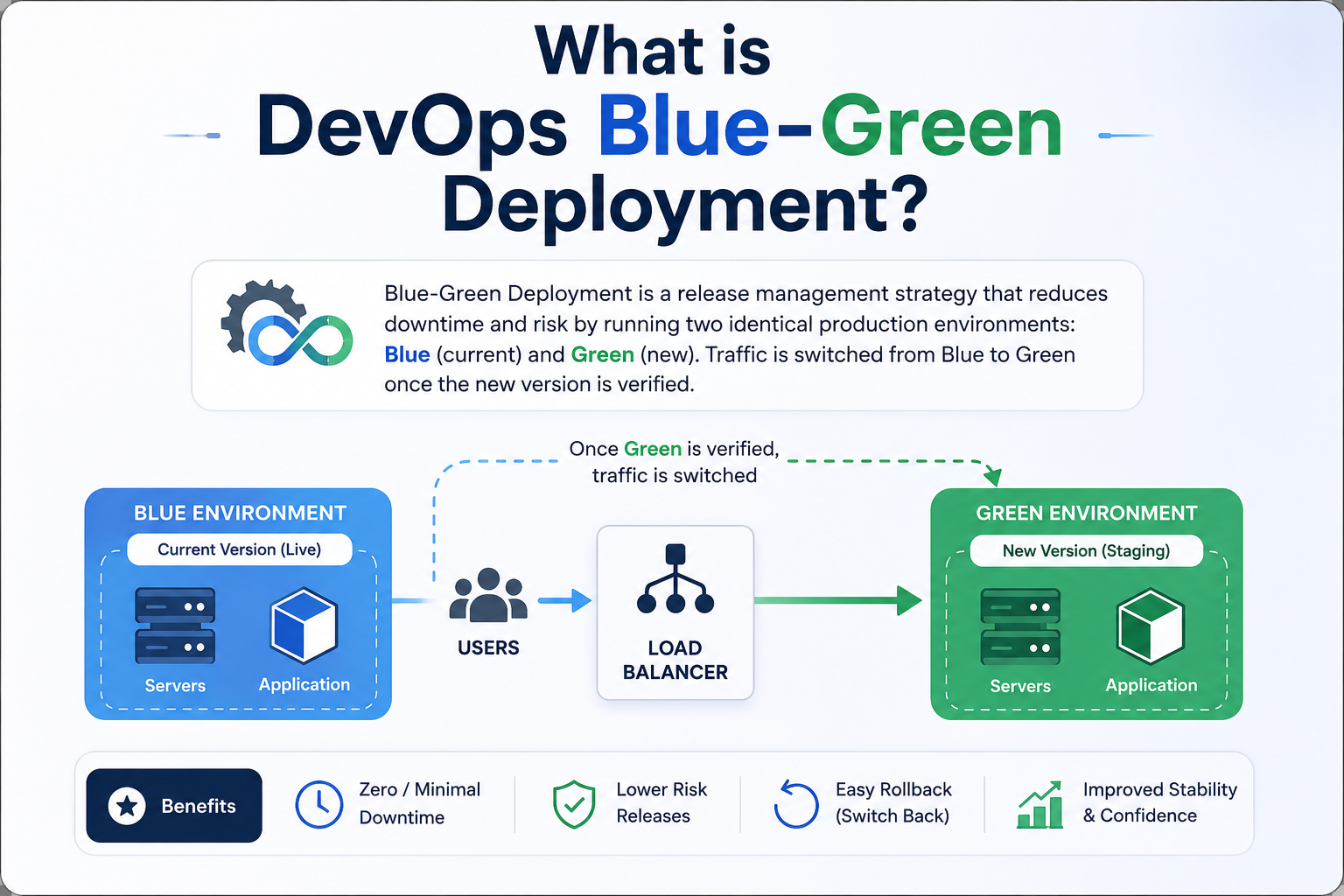
DevOps Blue-Green Deployment is a release strategy that uses two identical production environments.
- Blue Environment – The live production environment currently serving users.
- Green Environment – The new version of the application where updates are tested before going live.
Once the Green environment is fully tested, user traffic is switched from Blue to Green. If any issues are detected, traffic can quickly be redirected back to the Blue environment.
This approach minimizes downtime and reduces deployment risks.
How Does Blue-Green Deployment Work?
The process is simple:
Step 1: Deploy the New Version
The updated application is deployed to the Green environment while users continue accessing the Blue environment.
Step 2: Test the Environment
Development and Iamops QA teams verify that the new version works correctly.
Step 3: Switch Traffic
After successful testing, the load balancer redirects users from the Blue environment to the Green environment.
Step 4: Monitor Performance
The new environment is monitored to ensure stability.
Step 5: Roll Back if Needed
If problems occur, traffic is immediately switched back to the Blue environment.
This makes deployments safer and easier to manage.
Benefits of DevOps Blue-Green Deployment
1. Zero or Minimal Downtime
Keep applications available while deploying new versions.
2. Easy Rollback
Quickly switch back to the previous version if issues occur.
3. Reduced Deployment Risk
Test updates before directing live user traffic.
4. Better User Experience
Deliver seamless updates with fewer service interruptions.
5. Faster Releases
Automate deployments for quicker and more reliable software releases.
Blue-Green Deployment works particularly well with modern DevOps pipelines.
Popular CI/CD tools include:
- Jenkins
- GitHub Actions
- GitLab CI/CD
- Azure DevOps
- AWS CodePipeline
Container platforms like Docker and Kubernetes also simplify Blue-Green deployments by automating infrastructure provisioning and traffic routing.
Blue-Green Deployment in DevOps CI/CD
Blue-Green Deployment works particularly well with modern DevOps pipelines.
Popular CI/CD tools include:
- Jenkins
- GitHub Actions
- GitLab CI/CD
- Azure DevOps
- AWS CodePipeline
Container platforms like Docker and Kubernetes also simplify Blue-Green deployments by automating infrastructure provisioning and traffic routing.
When Should You Use Blue-Green Deployment?
Blue-Green Deployment is ideal when:
- High application availability is required
- Downtime must be avoided
- Applications serve large customer bases
- Fast rollback is essential
- Business-critical services require continuous uptime
Conclusion
DevOps Blue-Green Deployment is one of the most reliable deployment strategies for organizations that need fast, secure, and zero-downtime software releases. By maintaining two production environments, businesses can deploy updates with confidence, minimize risks, and quickly recover if issues arise.
While Blue-Green Deployment is an excellent choice for many applications, organizations should also evaluate other strategies such as Canary, Rolling, Recreate, and A/B deployments based on their infrastructure, traffic patterns, and business requirements.
By combining Blue-Green Deployment with automation, CI/CD pipelines, and continuous monitoring, businesses can achieve faster releases, improved reliability, and a better experience for their users.